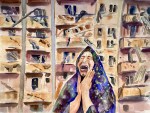
PLACE OF BIRTH IS NOT A CHOICE
Gaza” means “strength” in Arabic. About 1.7 million of the 2.2 million people in Gaza are refugees from the war that established Israel in 1948. Gazans call this displacement the Nakba, or “the catastrophe.”
On Oct. 7, 2023, Hamas fighters attacked southern Israel, killing about 1,200 people and taking about 250 others back to Gaza as hostages. Since then, Isreal has killed more than 70,000 Palestinians.
Palestinians, who are in the U.S. either temporarily or as immigrants, face challenges. Since the U.S. does not recognize “Palestine” as a country, it considers Gazans stateless. Fearing both Hamas and Israel, some Palestinians seek asylum in the U.S. However, asylum is almost impossible because in August 2025, the U.S. suspended visas for Gaza residents and restricted Palestinian asylum cases. Only rare B1/B2 visitor visas permit Palestinians to seek medical treatment in the US.
During the war, mass evacuation and airstrikes have driven more than 90 percent of the population from their homes according to the U.N. Almost all of Gaza’s cropland has been damaged, fishing vessels have been destroyed, and livestock has been killed according to the U.N. (Oct 2025). As a result, unemployment in Gaza is over 80% and poverty is over 95%. As of September, at least 500 people are confirmed to have died of starvation according to the Gaza Health Ministry.
Notably in 2019, the Gaza Strip had 97% literacy, one of the highest literacy rates in the world, according to U.N. figures. Now, 92% of schools have been destroyed.
Before the war, Gaza had a robust health care system, according to Doctors Without Borders. Oct 2025. Now it is in a state of near collapse. More than 94 percent of hospitals are damaged or destroyed and more than 1,700 health workers have been killed.
October 10, 2025 marked a fragile peace treaty between Hamas and Israel. It includes return of 20 living Israeli hostages, 2000 Palestinian prisoners, a partial Israeli troop withdrawal, eventual Palestinian rule, the beginning of food and health aid, the destruction of Hamas, the demilitarization of Hamas, and international peacekeeping forces.
 Jean Kigel Studio + Gallery